A shell and a society of stairs—and then what?
Building study, V&A East, O'Donnell + Tuomey
The new V&A East surprises and delights, but fails to go far enough for those it claims to serve
Outside the new V&A East museum in Stratford waterfront, a passerby likens its form to a scuttling crab. Architect Eimear Hanratty of O’Donnnell + Tuomey, the practice behind the project, opts for more cultural metaphors: drooping sleeves in a Vermeer, a classic Balenciaga dress. Someone even mentions a John Lewis toaster. I’m yet to figure out what that was all about.
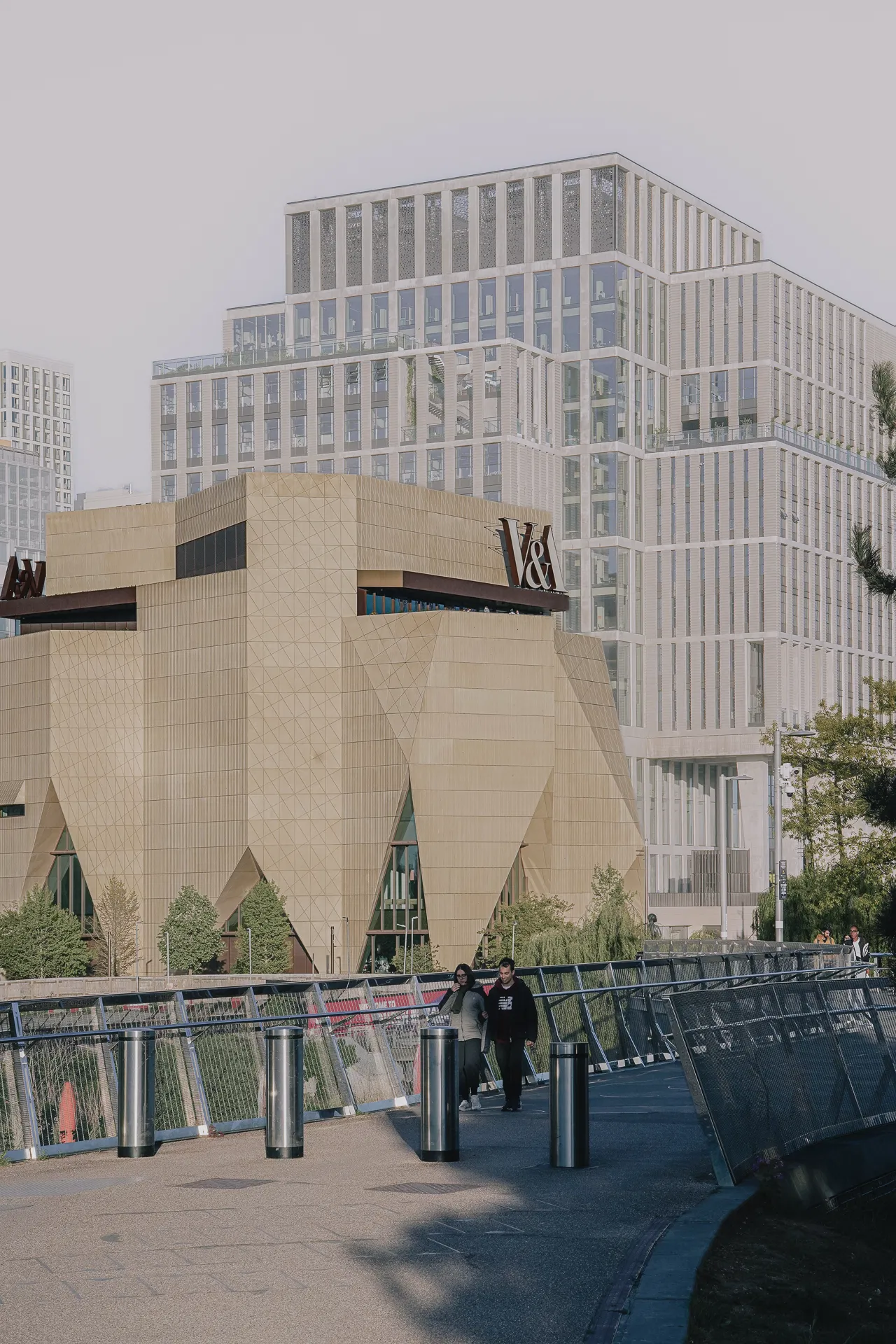
Clearly, the solid, angular shell of camel-coloured panels, ‘lifted up’ on the bottom to reveal dramatic entrances and openings, lends itself well to imaginative comparisons. The crab-dress building evokes even before visitors set foot inside it, especially against the more regular and rhythmical London College Fashion (LCF) next to it. Another outpost of V&A’s South Kensington mothership, it’s a key piece of the £628m masterplan transforming Stratford from an Olympics site into East London’s cultural quarter. If distinctive architecture functions as a tool for cultural institutions to brand themselves, the fine-lined triangles of the museum coalesce into a beacon of craft and culture—perhaps even standing in for the entire waterfront, consisting of much less gutsy buildings.
For all the analogies hired to describe the museum’s outer shell, though, Hanratty is much more excited to speak about its interior sequence. Indeed, as architects, O’Donnell + Tuomey have always been interested in subtle experiences, lines of sight, and meticulously framed compositions. They have consistently produced complex buildings that can only be understood by being in them over time.
At V&A East, the architects’ signature attempt at spatial complexity is made in that gap between the two diverging layers of the building: the shell and the central spaces for exhibition and storage. Admittedly, stepping into the lobby without a reception feels compressed and disorienting; but as you work your way up, you encounter a society of unfamiliar yet generous stairs, connecting the museum’s three galleries—one ticketed, two free. One set of softly lit stairs reveals itself after another, turning at unexpected angles, before ultimately leading to stunning views of the city on the roof terrace. The pleasantly abrupt small viewports looking up and down, the swooping views out through the lifted parts of the shell, and even the ceiling grill repeating the rhythm of the stairs add to the sequential moments of delight. The ascent is reminiscent of medieval hill towns, with their swerving alleys and views appearing out of nowhere.
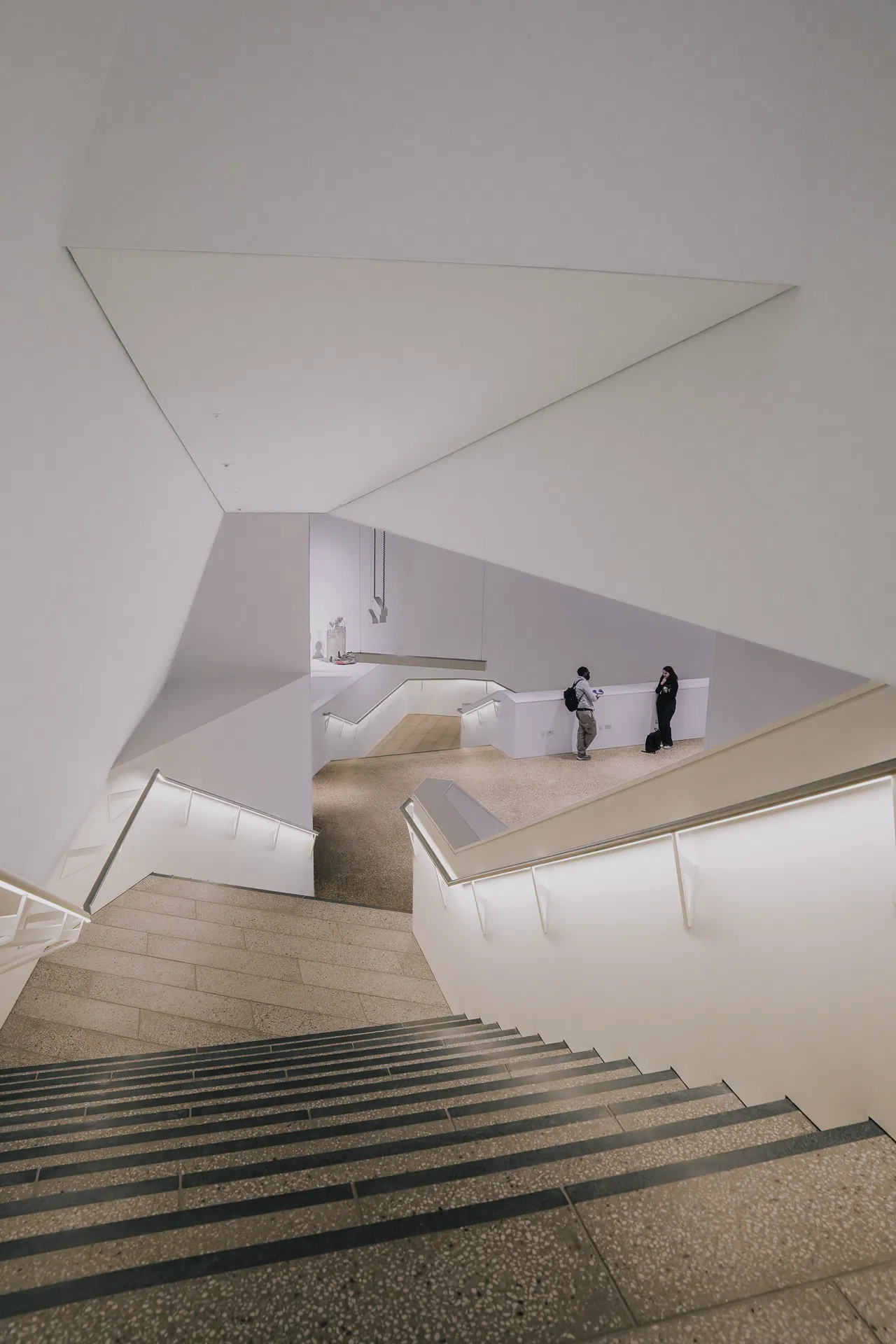
The museum really aspires to inject an urban quality to a cluster of cultural institutions dropped onto what’s essentially a giant, new, sparsely inhabited park. The two entrances—one on ground level and another on podium level, connected directly to the LCF entrance—are equal openings through which visitors can wonder in and out; the lobbies, foyers, and stairs bring in the terrazzo surfaces of the landscaping around the building to blur the building threshold.
Despite such admirable urban gestures, though, V&A East can’t escape from the fact that no space inside it can attract anyone who isn’t there to see and exhibition or pay for specialty coffee at the lobby café. The main lobby and subsequent foyers feel like spaces to quickly move through rather than linger in, and the cozy learning space is locked away behind a gallery. The seating on offer—a lonely bench beside a storage room, a plinth slotted into a staircase landing—feel closer to airport chairs than to something more welcoming. Unlike, say, Tate Modern’s 2016 extension or even its neighbour LCF, you can’t picture someone strolling into V&A East to finish a Pret sandwich or to get stuck into a novel.
V&A East was conceived as a more local and community-grounded version of its South Kensington cousin, and its free galleries host permanent displays featuring the work of London’s grassroots designers. It appears that, in the architects’ attempt to create a dramatic sequence of spaces, this commitment to communities has largely been overshadowed. The museum will be a wonder on anyone’s first visit, but—given its lack of comfortable spaces to linger in and come back to—I doubt it’ll make many longstanding friends, especially among its Stratford neighbours.